
“There is no such thing on Earth as an uninteresting subject; the only thing that can exist is an uninterested person.”
— Philosopher G.K. Chesterton
Students constantly claim that math is “boring.” Their eyes glaze over at the sight of an algebra textbook, and they count down the minutes until the next class (ironically, using math to do it).
But it doesn’t have to be that way. Math is anything but dull. It’s the language of problem-solving, design, technology, construction, medicine, finance, and engineering. Name a career, and math plays a role in improving, guiding, or enhancing it.
The real issue isn’t math itself; it’s how math is often presented. Too many students experience math as a checklist of procedures to memorize rather than a meaningful tool they can use now and in the future. When learning feels disconnected from life outside the classroom, interest fades, and with it, confidence and performance.
So, what’s the fix? Make math relevant. Or rather, showcase the relevance it already has.
Students become far more engaged when they can clearly see how math connects to their lives, interests, and career goals. Relevance creates curiosity, and curiosity fuels learning.
Here are 11 creative, classroom-ready ways to help students see math not as something to get through but as something worth caring about.
1. Start Every Unit with a Career Hook
Rather than waiting until the end of a unit to talk about careers, begin with them. Use a “Career Connection of the Week,” a real job posting, or a quick prediction prompt like, “How might a game designer use today’s math skill?” or “Why would a business owner need to understand this concept?”
This simple shift reframes math as a useful tool, not an isolated academic subject.
2. Ground Math in Local Industries
Students engage more deeply when they recognize the careers around them—in the businesses they interact with and that shape their communities.
Bring in local labor market information, highlight professionals living and working nearby, or show videos of real workers explaining how math strengthens their jobs.
It’s an easy way to reveal how math already shapes each learner’s world.
3. Build Lessons Around Authentic Problems
Instead of worksheets that ask students to solve problems about imaginary party planners buying 47 watermelons or animals running impossible distances, give them tasks rooted in real challenges. Have students design a food truck layout, estimate materials for an irrigation system, analyze sports statistics, or calculate profit margins for a clothing store.
When problems feel authentic, students naturally lean into problem-solving.
4. Let Students Work as Consultants
Have small groups of students pretend they’re project teams tasked with solving a workplace challenge. Each group must present its solutions as if they’re pitching to a client or supervisor.
This structure boosts collaboration, communication, and applied academic reasoning—all employability skills that hiring managers say they value even more than technical skills.
5. Turn Daily Classroom Routines into Career Skill Practice
Turn everyday classroom moments into quick career connections.
For example, start class with “workplace warmups” or “career connection starters”, short prompts that build workplace skills like accuracy, time management, and problem analysis.
Students might answer questions like: “Find the error in this calculation. How could this mistake affect someone’s job?” or “Estimate how long this task will take you, as a technician or engineer would, and plan how to stay on track.”
These small routines help students see that math class isn’t just about numbers or theorems. They demonstrate how habits and thinking patterns learned today can translate directly to careers tomorrow.
6. Co-Create Norms Like a Workplace Would
Invite students to help develop classroom expectations, project rubrics, and communication agreements. Then anchor those norms to workplace readiness concepts like punctuality, collaboration, accuracy, and responsibility.
You’re not just teaching content; you’re building a future-ready mindset.
7. Bring Self-Reflection into the Equation
Reflection isn’t just a nice-to-have that fills up time. Getting into the habit of self-reflection strengthens student learning and confidence.
Encourage students to use math journals, end-of-week reflections, or quick prompts like:
- “I improved at…”
- “This skill might help me in…”
- “A career that uses this math is…”
When students articulate what they’re learning, they begin to finally internalize it.
8. Showcase Math Through Multiple Lenses
Help students see that math is about reasoning, not just getting the right answer. Try activities like:
- Gallery walks: post student solutions or projects around the room and have peers circulate, compare approaches, and leave feedback.
- Math in the news: start class with a graph, table, or statistic from a recent news article and ask students to interpret it or pose questions.
- Data talks: display a chart or data set from a real-world source and guide students to discuss what it shows, what questions arise, and how they might solve related problems.
These strategies make thinking visible, encourage discussion, and help students see multiple ways to approach a problem. They make it clear that making mistakes and trying different strategies is a totally normal (and healthy) part of the math process.
9. Offer Choice in How Students Demonstrate Learning
Flexible project formats let students showcase their knowledge and skills in ways that align with their strengths and interests. For example, a student might create a short video explaining a concept, design a poster or infographic to visualize data, build a 3D model of a structure, or produce a prototype to solve a real-world problem.
Providing options not only encourages creativity but also mirrors how professionals communicate and solve problems in diverse ways.
10. Bring Industry Voices Into the Classroom
Whether through in-person guest speakers, virtual tours, or career-story videos, industry voices often deliver the “aha moment” students need. Hearing real professionals explain how they use math every day makes learning feel immediately relevant.
11. Better Yet: Partner with Pathway2Careers (P2C)
Every idea above becomes easier and even more powerful when paired with high-quality, career-connected math materials. P2C Math and Math Bridge are designed to help teachers make math relevant by default — through real job scenarios, authentic career stories, and scaffolded problem-solving tasks that show students why math matters.
Instead of piecing these strategies together on your own, you can rely on a research-backed curriculum that seamlessly integrates career connections into daily instruction. It’s one of the most effective ways to boost engagement, confidence, and achievement, especially for students who otherwise may insist that “just not good at math.”
Want more ready-to-use ideas?
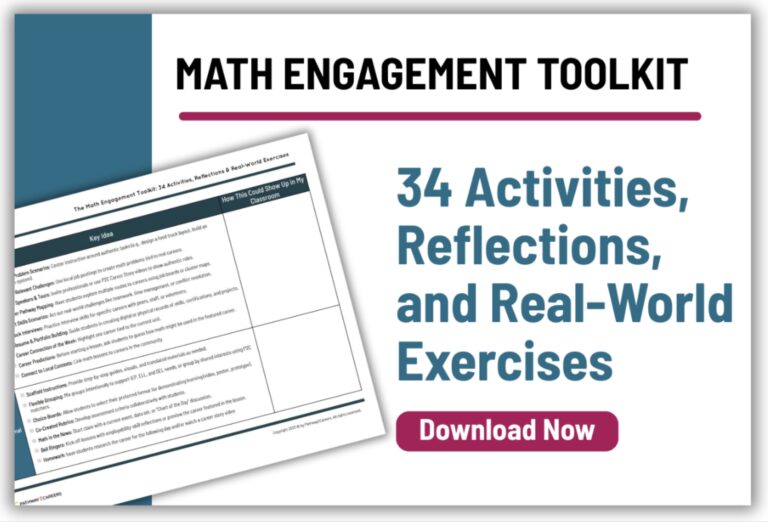
We created a free, downloadable ideas sheet featuring 34 creative strategies and activities you can use to make math meaningful, relevant, and fun—anything but boring.
It’s packed with classroom routines, discussion structures, reflection prompts, soft-skill tasks, and more. Whichever level of math you teach, you’ll find something you can use right away.
Download it by filling out the short form below.