

Moving Beyond Compliance
How do you transform a compliance exercise into a catalyst for change?
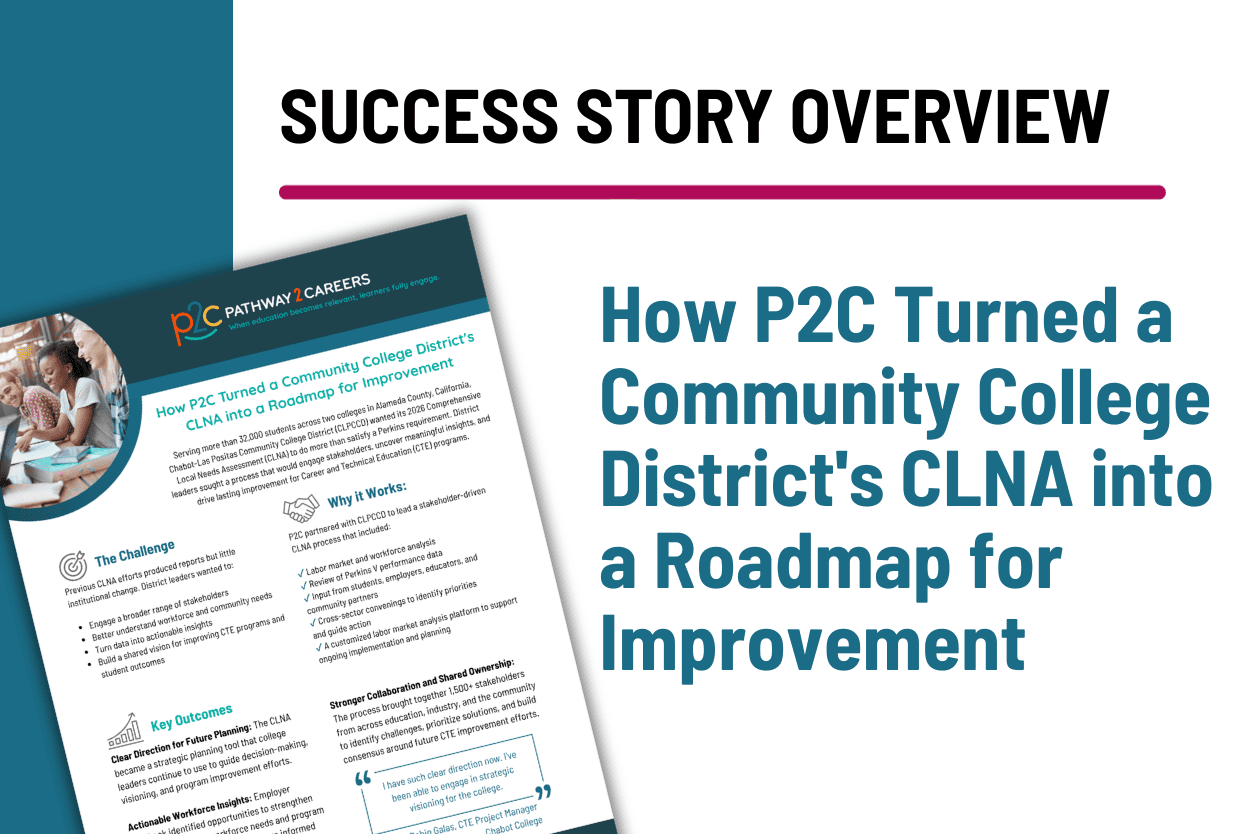
That’s the question that the Chabot-Las Positas Community College District (CLPCCD) was asking, as they approached the 2026 Comprehensive Local Needs Assessment (CLNA) for their Career and Technical Education programs.
Comprising two colleges, the district serves more than 32,000 students in Alameda County, CA, of whom 17,453 are Career Technical Education (CTE) students. The colleges serve nine feeder school districts, a culturally diverse populace, and its colleges are designated as Hispanic, Asian-American, Native-American, and Pacific Islander-Serving Institutions. Nearly half of its students are the first in their family to pursue a degree.
Las Positas College’s Vicki Shipman and Chabot College’s Robin Galas serve as Career Technical Education Project Managers for their respective institutions. They were each looking to use the CLNA process as an opportunity to create a strategic action plan for their colleges to better serve the needs of their communities, especially students and employers. Dissatisfied with prior CLNA efforts which generated no institutional change, Shipman went looking for a potential partner in this effort and found Pathway2Careers, a national leader in Career-Connected Learning.
“There had been no stakeholder engagement before,” Shipman said. “The consultant wrote up the CLNA based on information they gathered from a regional perspective.”
Galas said, “People who had been through last year’s said, ‘I don’t even remember what happened last time.’ Pathway2Careers was incredibly thoughtful to say, ‘What is our outcome, and how are we going to get there?’ And understanding that, if we’re going to get there, it cannot be an echo chamber of the same people in the same space saying the same things to one another. We’ve got to mix people up. There’s a value in this multitude of perspectives, and we’re going to construct our meetings and our space in an intentional way to design for what we want.”
Engaging Stakeholders Across the District
The CLPCCD and P2C teams engaged in a four-month process to deeply engage stakeholders about the role of the community college district in building strong, sustainable talent pipelines capable of driving their respective communities forward. Perkins Core Indicator data was provided by another long-term partner with the district, but there was a need to understand what the numbers were saying about the colleges’ ability to execute high-quality CTE programs.
Together, the teams developed a process to prioritize stakeholder engagement throughout, including surveys of:
• 1,200 current students
• 200 dual enrollment high school students
• 60 regional employers
• 54 K-12 CTE Partners
• 108 institution-related faculty, staff, counselors, and deans
• Interviews with representatives of community partners serving special populations
Turning Data into Shared Understanding
A deep analysis of labor market data combined with overarching findings from the surveys set the stage for two cross-sector stakeholder convenings. The P2C team shared the data and then led diverse, cross-sector stakeholders in collaborative conversations to understand the issues and opportunities revealed in the data, then structure conversations to collectively identify and prioritize solutions.
“The data is very confusing,” said Galas. “I could see when somebody throws up something from Data Mart, the state data site, their eyes are going to glaze over. P2C was really good about, okay, if we’re going to use data to support this process, then we’ve got to make that data accessible. Trevor [Stokes, P2C Vice President of Career Readiness Initiatives] was brilliant at this. Trevor was like, ‘The way people are going to connect to the data is through story, so let me tell you a story about this data.’”
Facilitating Cross-Sector Collaboration
Built on the solid foundation of labor market data, stakeholder survey responses, and Perkins Core Indicator Data, two stakeholder convenings one month apart put community voice at the forefront. Working in cross-sector teams, participants discussed the issues, identified solutions, and agreed upon actions that ultimately shaped the CLNA while sparking the fire for shared ownership of change.
Shipman said, “I’m hoping that the process that P2C facilitated, and how we brought together all the stakeholders is going to make a difference to transform how we’re providing services for our students and the employers. I think a lot of people’s eyes were opened.”
“That’s something that I’ve been hearing feedback around. People felt it was meaningful, because the process felt meaningful,” Galas added.
From Assessment to Action
With the CLNA completed, both colleges are now using the data and shared decisions from the report to drive change.
For example, the employer survey revealed gaps that the colleges have an opportunity to fill. They identified a set of required skills and highly rated employability or “soft” skills as important for workforce talent. However, that input places the CTE project managers in well-informed position to work with faculty and deans on the design of the programs and curricula.
“We have several different employers that hire and our students, and we place them in internships,” Shipman explained. “Well, have they dived into the curriculum to make sure that we’re providing the skills, not just soft skills, but technical skills that they’re going to need when they go out and work at the labs or at the firms that support the labs? Are we actually providing the technical skills that the students need?”
Galas said, “I have such clear direction now. I’ve been able to engage in strategic visioning for the college. Our president has been insistent for the past two years that every division, area, program, do a SWOT, (Strengths, Weaknesses, Opportunities, and Threats). The CLNA really is like a very complicated SWOT that I return to again and again. And I also think it was extraordinarily eye-opening for folks to look at the labor market information. That piece that was referenced in a current report for our foundation. They were using labor market information from the CLNA as proof positive for X, Y, and Z (initiatives).”
Building Momentum Across the District
Using the CLNA as a mechanism for change, both managers saw the impact the process had in bringing the district office and the colleges into closer collaboration.
Shipman said, “(P2C) was able to bring together the three entities under our district to start working together. From that meeting, our district foundation is also going to be engaging more with workforce development because of their attendance at the meeting. P2C definitely set us up for success.”
Galas agreed. “I’m so enthusiastic about the work moving forward. So many people were so complementary that Tracey (Bryan, part of the P2C team) and Trevor built trust with our institution. And there’s a real desire to say, ‘You accompanied us on this journey. You were intimate with the process. You saw what was going on, and there’s real trust for you to stay and carry us into the action items and the work in the future.”
Pathway2Careers is continuing to support the CLPCCD team in moving forward in the next steps for change