
Career exploration is often regarded as a fun bonus or “extra” in education. When it happens (if it does at all), it’s treated as a break from garden-variety classroom learning, rather than an essential part of student development. Educators toss in an occasional career day, a counseling session, or a field trip—and leave it at that.
Yet, many students are asked to make important decisions about their futures long before they understand their own interests, values, strengths, or opportunities. They’re tasked with selecting courses, pathways, certifications, and postsecondary plans while still trying to answer a much bigger question: “What does my future actually look like?”
That’s why treating career exploration as optional enrichment anymore will only continue to do learners a massive disservice. Any educator interested in helping students envision a rewarding future must invest now in making the purpose of education crystal clear to students, every day.
The motivation problem schools can’t ignore
Many students struggle to answer broad yet vital questions like:
- Why am I learning this?
- What am I good at?
- What careers even exist?
- How does school connect to my future?
And when they don’t receive satisfying answers to these questions, they may conclude that their coursework has little-to-no relevance to their lives—and disengage.
It’s understandable. Would you keep reading a self-help book or listening to an education podcast if none of the advice spoke to the realities of your life or work?
Academic disengagement doesn’t always come from a lack of ability; it often comes from a lack of connection.
Career exploration helps bridge that gap. Instead of viewing school as a series of disconnected assignments, students are able to connect their interests and goals to real-world pathways. School becomes a means to an achievable end—one that students can see the clear rewards for engaging in.
Career exploration changes student outcomes
It’s not just theory; career exploration is strongly associated with measurable student outcomes.
Research on career academies found that participation increased the likelihood of high school graduation by approximately 8 percentage points.
Other studies have found that structured career exploration programs can positively impact students’ motivation, career self-efficacy, and academic performance:
✅ When paired with targeted career counseling, career pathway models correlated with increases in students’ academic and career self-efficacy, motivation to complete school, and willingness to take more challenging courses.
✅ Career self-efficacy and career-related motivation may be linked to increased persistence and academic success.
Career exploration can also help students:
✅ identify career pathways aligned to their interests and values
✅ understand postsecondary options
✅ develop stronger long-term goals
Crucially, effective career exploration doesn’t pressure students to pick and stick with a career path too early. It focuses on helping students better understand themselves and the opportunities available to them. Successful programs guide students toward becoming more confident in envisioning their futures and making data-informed decisions over time.
Career exploration is just about picking a job
Strong career exploration programs go far beyond personality quizzes or career-day presentations.
Effective career exploration helps students:
✅ explore a wide range of career pathways
✅ connect academics to real-world applications
✅ understand labor market trends and opportunities
✅ build awareness of postsecondary options
✅ develop long-term plans and goals
Frameworks like the National Career Clusters Framework® can help students organize and explore careers in a more structured, less overwhelming way. By grouping occupations into broader industries and pathways, students can begin exploring areas aligned to their interests while learning about related education and workforce opportunities.
The goal is not to force certainty, but to build awareness, direction, and confidence.
One savvy starting place? Our free Career Clusters posters, designed to print and display in classrooms, counseling spaces, and hallways. While activities and discussions drive deeper exploration, environmental cues like these posters help surround students with ongoing reminders of career pathways and possibilities.
What meaningful career exploration looks like
As with any essential message or discovery process within education, career exploration shouldn’t be a one-time-only event. It must be an ongoing process embedded throughout the student experience.
That can include:
✅ interest and values assessments
✅ exposure to real professionals and industries
✅ labor market and wage data
✅ pathway planning
✅ career-connected projects and activities
Schools are increasingly integrating career-connected learning directly into academic instruction, enabling students to regularly connect classroom concepts to real-world careers and opportunities. Over time, those repeated connections can shift students’ perceptions of school—from something arbitrary they’re required to endure to something illuminating that can actively shape their futures.
For example, P2C Career Explorer helps students connect their interests, values, and goals to real career pathways through lessons, assessments, and other career exploration activities. Meanwhile, P2C Math and P2C Math Bridge integrate career-connected learning into math, illuminating answers to the age-old question: “Why does math matter?”
Districts are also increasingly using tools like Labor Market Navigator to align pathways and programs with regional workforce demand, helping students explore opportunities connected to high-value, in-demand careers and industries in their communities.
What career exploration looks like in real school
Some schools are moving beyond isolated career days and creating career-connected learning experiences across grade levels and subject areas.
That might include:
✅ embedding exploration activities into advisory or counseling programs
✅ helping students explore careers tied to their interests and strengths
✅ connecting academics to local workforce opportunities
✅ using labor market data to guide pathway development
The strongest programs are strategically woven into the student experience over time, giving students repeated opportunities to explore, reflect, and make connections.
You can explore examples of how schools are implementing career-connected learning in practice through our free guide: What Career Exploration Looks Like in Real Schools.
Invite students to help develop classroom expectations, project rubrics, and communication agreements. Then anchor those norms to workplace readiness concepts like punctuality, collaboration, accuracy, and responsibility.
You’re not just teaching content; you’re building a future-ready mindset.
Career Exploration = student success strategy
If we expect students to make meaningful decisions about college, careers, and life after graduation, we can’t leave career exploration to chance.
Students need opportunities to discover who they are, explore what’s possible, and understand how their education connects to the future they want to build.
See how schools are implementing career exploration in practice.
Download our free guide.
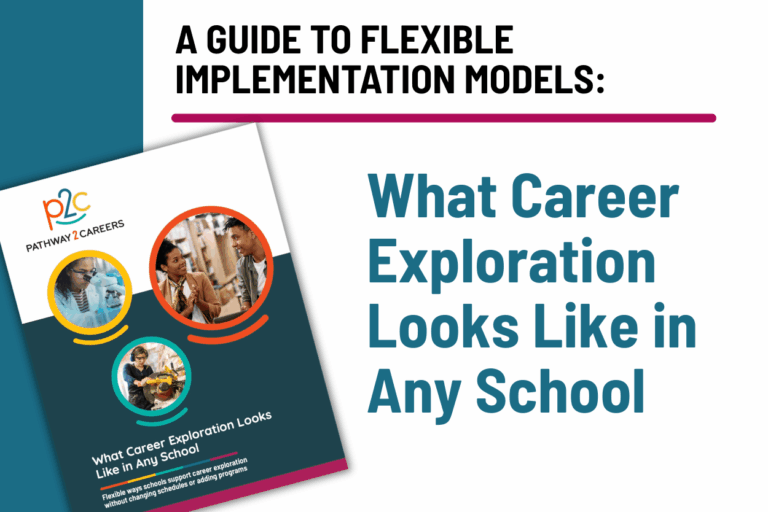
Inside, you’ll see examples of how schools:
✅ Embed career research into core academic & CTE classrooms
✅ Support senior capstones and postsecondary planning
✅ And more!
Fill out the form below to instantly access your copy.