
Career and Technical Education (CTE)

This August 2026 report from RAND examines career-connected learning in U.S. public schools, drawing on nationally representative surveys of school district leaders, principals, and students during the 2025–2026 school year. It explores how schools support college and career planning, career exploration, and work-related learning, and whether students are able to participate in the experiences they intend to pursue.
The findings highlight gaps between students’ plans and their participation in workplace visits, internships, and apprenticeships, along with an emphasis on four-year college pathways that can leave other options underrepresented. The report also examines how schools track career and postsecondary planning and identifies opportunities for education leaders and policymakers to strengthen career-connected learning and better support students with different goals after high school.
The findings highlight gaps between students’ plans and their participation in workplace visits, internships, and apprenticeships, along with an emphasis on four-year college pathways that can leave other options underrepresented. The report also examines how schools track career and postsecondary planning and identifies opportunities for education leaders and policymakers to strengthen career-connected learning and better support students with different goals after high school.

This report from the National Cross-Partisan Education Policy Network’s Career-Connected Learning Working Group examines how career-connected learning can help address declining academic achievement, student disengagement, and uncertainty about the purpose of education. It challenges the perceived trade-off between academic rigor and career preparation, arguing that students benefit from mastering core academic skills alongside the skills needed for modern work.
The report calls on education leaders, employers, policymakers, and communities to expand access to high-quality career-connected learning and build stronger connections among classroom learning, career opportunities, and economic development.
The report calls on education leaders, employers, policymakers, and communities to expand access to high-quality career-connected learning and build stronger connections among classroom learning, career opportunities, and economic development.

Published by Bain & Company, this report examines how career-connected learning can better prepare students for high-demand careers while helping employers build stronger talent pipelines. Drawing on research, employer interviews, and examples from successful initiatives across the country, it outlines strategies for expanding high-quality career-connected learning through stronger partnerships among schools, employers, higher education, and policymakers.
The report highlights the importance of work-based learning, aligned credentials, and coordinated public policy to ensure more students have equitable access to career pathways that lead to long-term economic opportunity.
The report highlights the importance of work-based learning, aligned credentials, and coordinated public policy to ensure more students have equitable access to career pathways that lead to long-term economic opportunity.

Published by Bellwether, this report examines how Colorado, Delaware, Tennessee, and Texas have developed statewide ecosystems that support multiple career-connected learning models. Drawing on policy analysis, document review, and interviews, it identifies the governance structures, cross-sector partnerships, funding strategies, and state policies that enable career academies, CTE, early college, dual enrollment, and youth apprenticeships to grow together rather than in isolation.
The report offers practical lessons and policy recommendations for state leaders seeking to build coordinated, sustainable systems that expand access to high-quality career-connected learning opportunities for all students.
The report offers practical lessons and policy recommendations for state leaders seeking to build coordinated, sustainable systems that expand access to high-quality career-connected learning opportunities for all students.

Published by Bellwether, this report synthesizes research and expert interviews to identify the policies that enable high-quality career-connected learning models to grow and succeed. It examines evidence supporting approaches such as career academies, CTE programs of study, dual enrollment, early college high schools, P-TECH, and youth apprenticeships, and outlines the state policies that support their implementation and long-term sustainability.
The report is intended to help policymakers and education leaders expand access to proven career-connected learning opportunities that improve students’ college, career, and workforce outcomes.
The report is intended to help policymakers and education leaders expand access to proven career-connected learning opportunities that improve students’ college, career, and workforce outcomes.

Conducted by Dr. Jay Plasman of The Ohio State University and published by the Thomas B. Fordham Institute, this study examines the postsecondary and workforce outcomes of Ohio high school students who earn industry-recognized credentials. Using longitudinal education and labor market data, the report analyzes how credential attainment and CTE concentration relate to graduation, college enrollment, employment, and earnings over time.
Findings show that students who earn credentials often experience early workforce earnings gains and higher graduation rates, though they are less likely to pursue four-year degrees. The study also explores differences across credential types, career clusters, and high-demand workforce pathways, offering insights for policymakers seeking to strengthen alignment between education and labor market needs.
Findings show that students who earn credentials often experience early workforce earnings gains and higher graduation rates, though they are less likely to pursue four-year degrees. The study also explores differences across credential types, career clusters, and high-demand workforce pathways, offering insights for policymakers seeking to strengthen alignment between education and labor market needs.

Career exploration introduced early in a student’s academic career can improve career aspirations and long-term planning—a core belief behind P2C’s innovative curriculum.
The findings indicate that when career examples are embedded within core content, career exploration becomes a pervasive part of the student experience. Increased self-awareness and career awareness foster purpose and meaning, which in turn strengthen students’ self-direction and hope for the future.
The report also suggests that early career and skill development supports more cohesive curricula aligned with students’ postsecondary and career plans.
The findings indicate that when career examples are embedded within core content, career exploration becomes a pervasive part of the student experience. Increased self-awareness and career awareness foster purpose and meaning, which in turn strengthen students’ self-direction and hope for the future.
The report also suggests that early career and skill development supports more cohesive curricula aligned with students’ postsecondary and career plans.

Details outcomes for students in NYC CTE-dedicated high schools, showing links between CTE, engagement, credit accumulation, and diploma on-track status
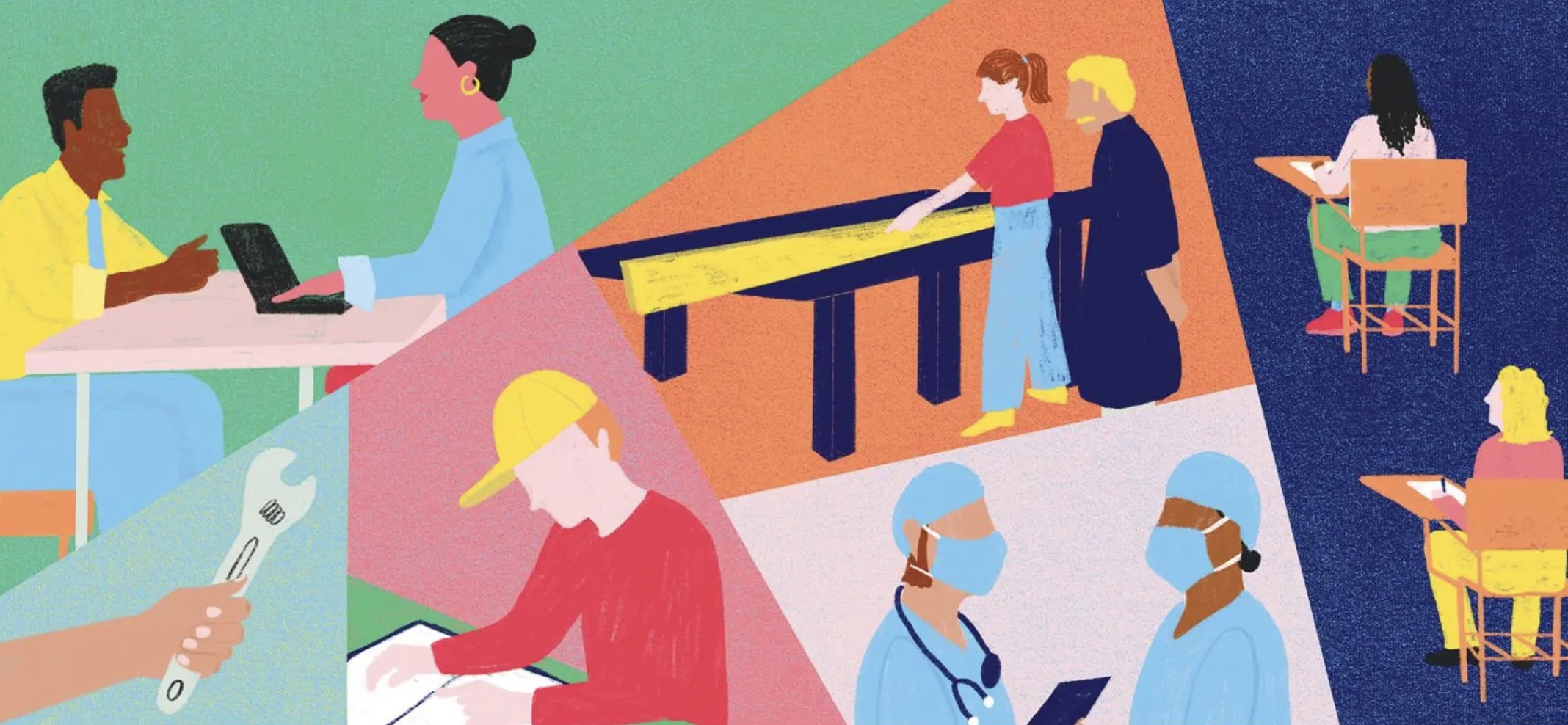
Explores how Massachusetts has transformed vocational education into a rigorous, inclusive model that integrates career pathways with academic achievement

Explores how the Youth CareerConnect program improves attendance, credit gains, and readiness through career pathways and partnerships